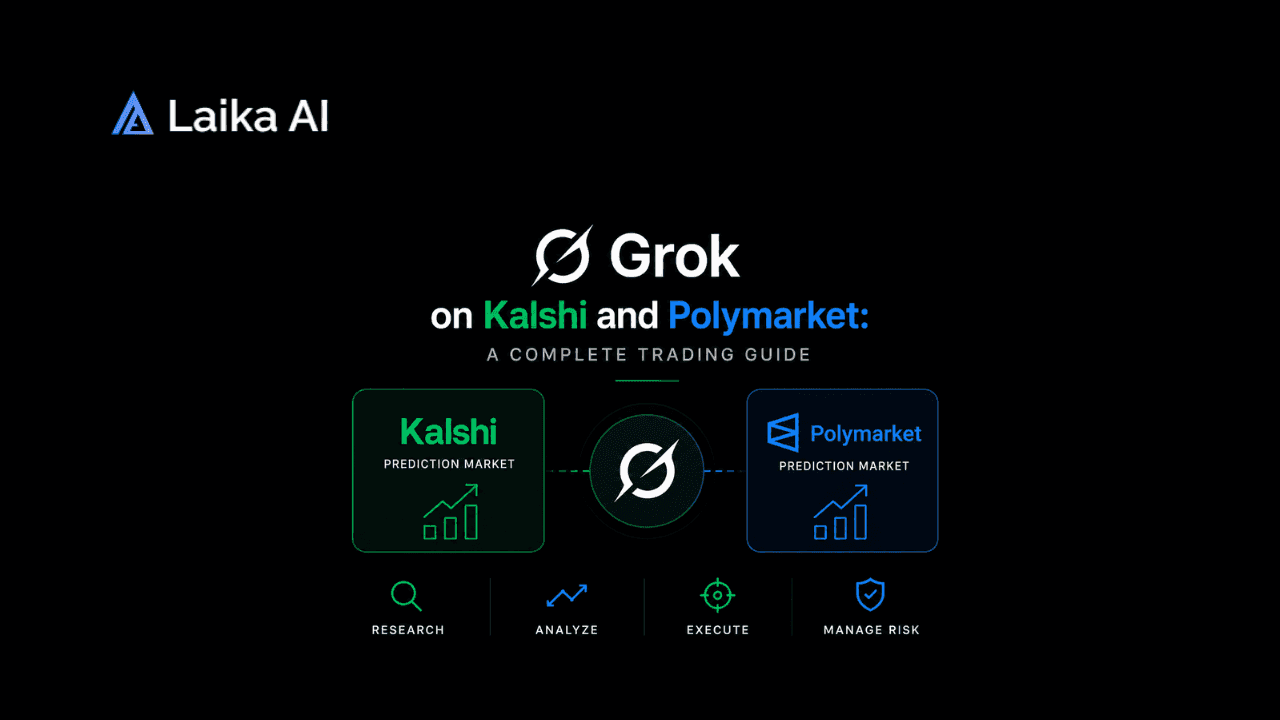
A grok Kalshi search usually starts with the same confused question: wait, is that actually built into the app, or is this just another partnership announcement that never ships? In Kalshi's case, it genuinely shipped. Grok sits directly inside Kalshi's trading interface now, offering context on a market before you place an order.
Polymarket took a related but different path. Instead of embedding Grok inside its own app the way Kalshi did, Polymarket leaned on X, running its integration through the social platform Grok already lives on. This guide covers how both versions actually work, what a Kalshi ai feature like this can and can't tell you, and where the two platforms genuinely diverge despite sharing the same underlying model. Neither company was first to the AI-on-prediction-markets idea either, and this specific kalshi ai rollout sits alongside a broader wave of similar deals, including a separate arrangement letting Kalshi's own market data surface inside ChatGPT. For the basics of Kalshi itself before layering AI on top, How Does Kalshi Work? A Complete Beginner's Guide is worth reading first if you're new to the platform.
How Grok Ended Up Inside Two Prediction Markets
The timeline here is messier than either company's press release makes it sound. Polymarket struck its deal with X first, announced in early June 2025, positioning Polymarket as the "official Prediction Market Partner" to X. Kalshi's version came later and took two tries. An earlier Bloomberg report about a Kalshi-xAI deal got retracted back in May, before the partnership was finally confirmed for real that July.
Both companies wanted the same thing: Grok's ability to summarize breaking news, X sentiment, and historical data quickly enough to matter during a live trading session. Musk's involvement in both platforms, through xAI on one side and X's distribution on the other, means his fingerprints are on more of this category than most traders probably realize.
How Grok Works Inside Kalshi
Kalshi's version lives right where you'd trade. Before placing an order, a trader can query Grok for context on a specific market, whether that's the current state of a political race, a Fed decision, or a sports outcome. Grok pulls from on-chain data, historical odds, and news to generate a probability style summary, right next to the order form itself.
That placement matters more than it sounds like it should. A tool that requires opening a separate app or browser tab gets used less than one sitting exactly where you're about to click buy. A working grok Kalshi setup means the context arrives at the exact moment a trader is weighing whether to act, not five minutes earlier in a different tab that's easy to forget about. The Block's coverage of the Kalshi-xAI partnership announcement is worth reading for the primary source on how the deal itself came together, separate from how the feature behaves in practice.
How Grok Works on Polymarket
Grok polymarket integration took a different shape entirely. Shortly after the X partnership was announced, Polymarket added a "Market Context" tool to its markets, generating a Grok powered overview that pulls in recent news and links back to relevant X posts. It's not a chat interface sitting inside the trading screen the way Kalshi's is. It's more of a generated summary card.
Then came something more unusual: an "Ask Polymarket" account launched directly on X in July 2025, described as "powered by Polymarket plus Grok 4." Ask it something and it responds in Grok's usual voice, sometimes with more personality than a financial tool probably needs. When there's no matching market for a question, it says so, and occasionally offers to pass the question along to Polymarket's own team. TechCrunch's coverage of the X-Polymarket partnership announcement goes into more detail on the deal mechanics, worth a read alongside how the feature actually behaves.
Grok Kalshi vs Grok Polymarket: What's Actually Different
Grok trading through Kalshi and through Polymarket end up feeling like two different products built on the same underlying model, not one feature deployed twice.
Neither approach is strictly better. Kalshi's version fits naturally into an actual trading workflow. Polymarket's version is more public facing and arguably more fun to poke at, but it's a step removed from the order screen itself. Anyone deciding between the platforms generally, not just on this feature, might find Kalshi vs Polymarket: Which Prediction Market Is Right for You? useful for the fuller comparison.
Can You Trust Grok's Market Analysis?
Here's where I'll be direct: no, not blindly, and Polymarket's own disclaimer says as much. The "Ask Polymarket" account explicitly states it's for "educational, entertainment, and scientific use only," not to be used for resolving events or as financial advice. That's not boilerplate legal caution. It's an accurate description of what the tool actually is.
Grok is a language model summarizing available information, not an oracle with privileged access to the future. It can miss context, misread a headline's significance, or simply be wrong about a probability in ways that are hard to catch unless you already know the topic well. Human traders still make the final call, and plenty of research on prediction market behavior suggests the crowd, not any single AI system, remains the better long run signal. Polymarket Bots vs. Human Traders covers a related version of this exact tension, worth reading if you're deciding how much weight to put on any automated input at all.
Grok vs Laika: Built-In AI vs a Dedicated Research Tool
Grok vs Laika: Built-In AI vs a Dedicated Research Tool
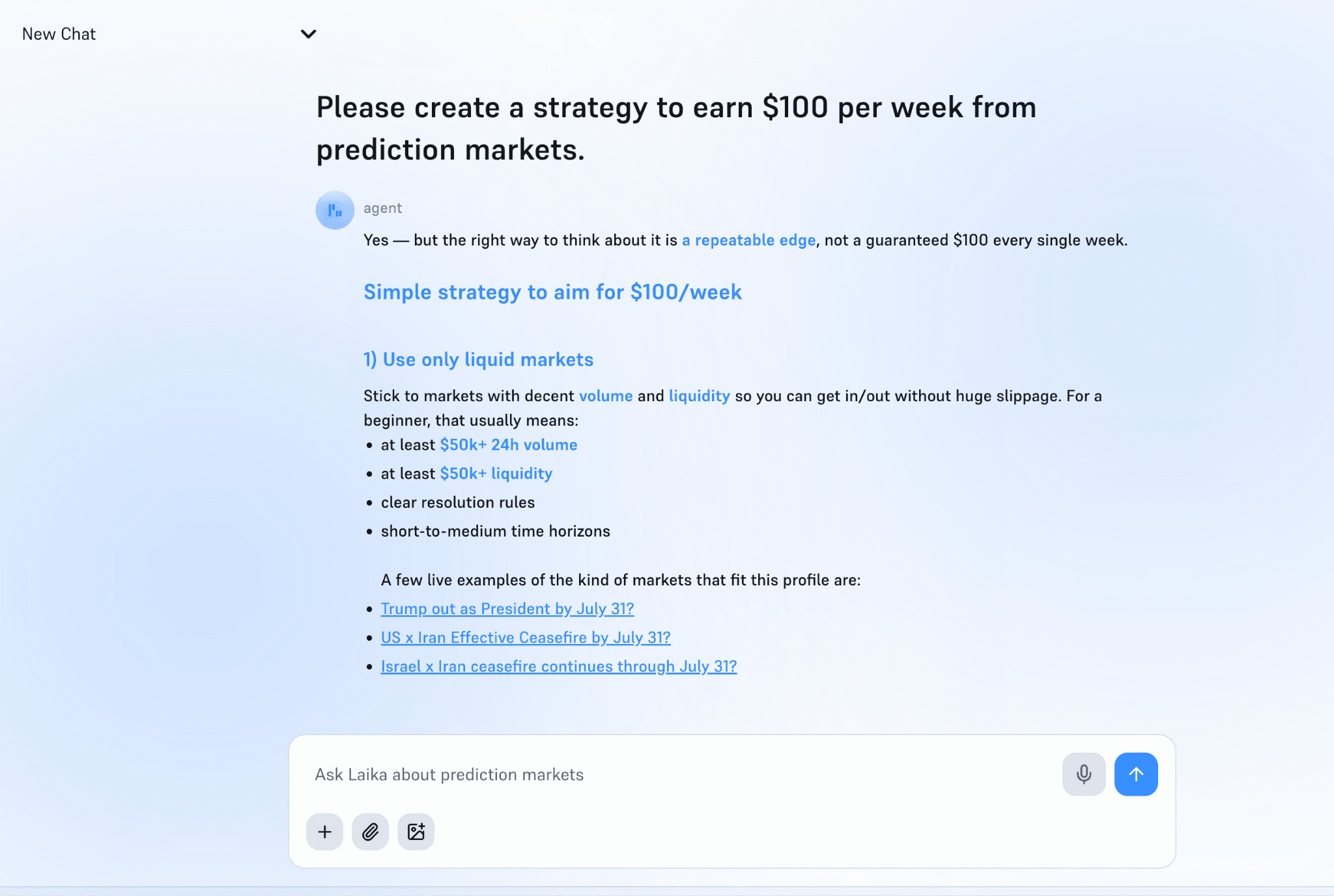
Grok isn't the only AI option floating around this space. Laika is a third party analytics platform built specifically for prediction market research, covering Polymarket, Kalshi, and several smaller platforms like Limitless and Manifold all in one dashboard. It's a genuinely different kind of tool than Grok, and worth understanding the distinction before assuming they compete head to head.
Grok is general purpose, built into the exchange itself, and free to use as part of your existing account. Laika is purpose built for cross-platform research specifically, tracking probabilities and comparing markets across venues Grok doesn't touch at all. If you only trade Kalshi or only trade Polymarket, Grok's built-in context is probably enough for casual use. If you're actively comparing prices across multiple platforms looking for discrepancies, a dedicated tool built for that exact job is going to serve you better than a general chatbot bolted onto one exchange. Traders doing that kind of cross-platform work often lean on open tooling too; Top 10 Free GitHub Repos for Polymarket Trading in 2026 covers several genuinely useful projects in that vein.
Want to see how Laika compares markets in real time? Try the Laika AI assistant and ask it anything about current probabilities across Polymarket, Kalshi, and more.
→ Try Laika Chatbot at https://laikalabs.ai/app/chatbot
Does Elon Musk's Involvement Affect Reliability?
Worth addressing head on, since it comes up constantly. Grok has drawn real, documented criticism for generating offensive and factually wrong outputs, including antisemitic content, something widely attributed to training choices and prompt engineering aimed at making the model less "politically correct" by design. That's not a rumor. It's been reported extensively and isn't seriously disputed by xAI itself.
Whether that pattern specifically undermines Grok's market analysis is a fair, harder question, and I don't think there's a clean answer yet. A model that's shown itself capable of generating clearly wrong or offensive outputs in one context deserves a healthy dose of skepticism in another, even one as seemingly neutral as summarizing Fed rate odds. Treat Grok's output the way you'd treat any single analyst's opinion as useful input, not gospel. Kalshi Prediction Market: 7 Strategies That Work in 2026 covers approaches that don't lean on any single AI tool as a crutch, which is probably the more durable way to build a trading process anyway.
Using Grok Well: Practical Tips
Treat Grok as a starting point for research, not a final answer. Ask it for context on a market you're already considering, cross check anything surprising against a second source, and never let a single AI generated summary talk you into a position size bigger than you'd otherwise take. Smart grok trading habits look a lot like smart trading habits generally: verify before you size up, and never treat one source, human or AI, as the whole picture.
Pairing Grok's context with your own payout math matters too. Running the numbers through Kalshi's payout calculator or Polymarket's payout calculator before committing size, rather than trusting a gut feeling after reading an AI summary, keeps the actual risk decision in your hands rather than the model's. A quick grok trade review habit worth building: read the summary, then independently check the two or three claims that would change your position size the most, rather than accepting the whole thing at face value. Position sizing discipline matters here more than people expect; Prediction Market Bankroll Management Guide covers exactly that, and it's a better foundation than any AI feature on either platform.
The Bottom Line
Grok Kalshi and Grok polymarket are genuinely useful additions, not gimmicks, but they're context tools, not trading signals you should follow blindly. Kalshi's version fits directly into the moment you're about to trade. Polymarket's version is more public, more playful, and a step removed from the order form itself.
Use either one to get up to speed faster. Don't use either one as a substitute for actually understanding the market you're trading. Traders building more automated approaches on top of either platform might find How to Automate Polymarket Trading Using a Claude Bot a useful next read, since combining AI research with disciplined, rules based execution tends to work better than leaning on a chatbot's live opinion alone.
FAQ
Is Grok built directly into Kalshi's trading interface?
Yes. Grok Kalshi integration puts AI generated context directly inside Kalshi's trading screen, letting users query for market background, probability assessments, and relevant news before placing an order, rather than requiring a separate app or browser tab.
Does Grok work the same way on Polymarket as it does on Kalshi?
No. Grok polymarket integration runs through a "Market Context" summary card on individual markets and a separate "Ask Polymarket" account on X, rather than a chat interface built into the trading screen itself the way Kalshi's version works.
Can I trust Grok's market analysis for trading decisions?
Not blindly. A grok trade review should treat the tool as a summarizing assistant, not an authoritative signal. Polymarket's own disclaimer describes its Grok powered account as being for educational and entertainment purposes only, explicitly not for financial advice or event resolution.
What is the "Ask Polymarket" account on X?
An ask polymarket grok query goes to a public account on X, described as powered by Polymarket and Grok 4, that answers user questions about Polymarket markets in Grok's characteristic conversational tone. It includes a disclaimer that responses aren't intended as financial advice or a source for resolving events.
How does using Grok inside Kalshi compare to asking it questions manually?
Grok trading through Kalshi's built-in feature pulls context specific to the exact market you're viewing, formatted for a trading decision. Asking Grok questions manually through X or a standalone chat interface can access the same underlying model, but without that direct tie to Kalshi's live market data and order screen.
Does Elon Musk's involvement in xAI affect the reliability of Grok's market analysis?
It's a reasonable concern to hold onto. Grok has faced documented criticism for generating offensive and inaccurate content in other contexts, which is worth factoring into how much weight you give its market summaries specifically, even though that criticism isn't primarily about its financial analysis capabilities.
Does Polymarket's Grok integration use Grok 4 specifically?
Yes. A grok 4 polymarket connection runs through the "Ask Polymarket" account on X, explicitly described as powered by Grok 4, xAI's more advanced model release, which the companies have highlighted for stronger reasoning and information retrieval compared to earlier versions